
how to stop dog from barking at door starts with one honest point, your dog is not being “bad,” they’re usually doing a job they believe matters, guarding, warning, or demanding access.
If the door sets your dog off every single time, you can train this without yelling, collar gimmicks, or hoping they “grow out of it.” What works best is a mix of management, teaching an incompatible behavior, and changing what the door sound predicts.
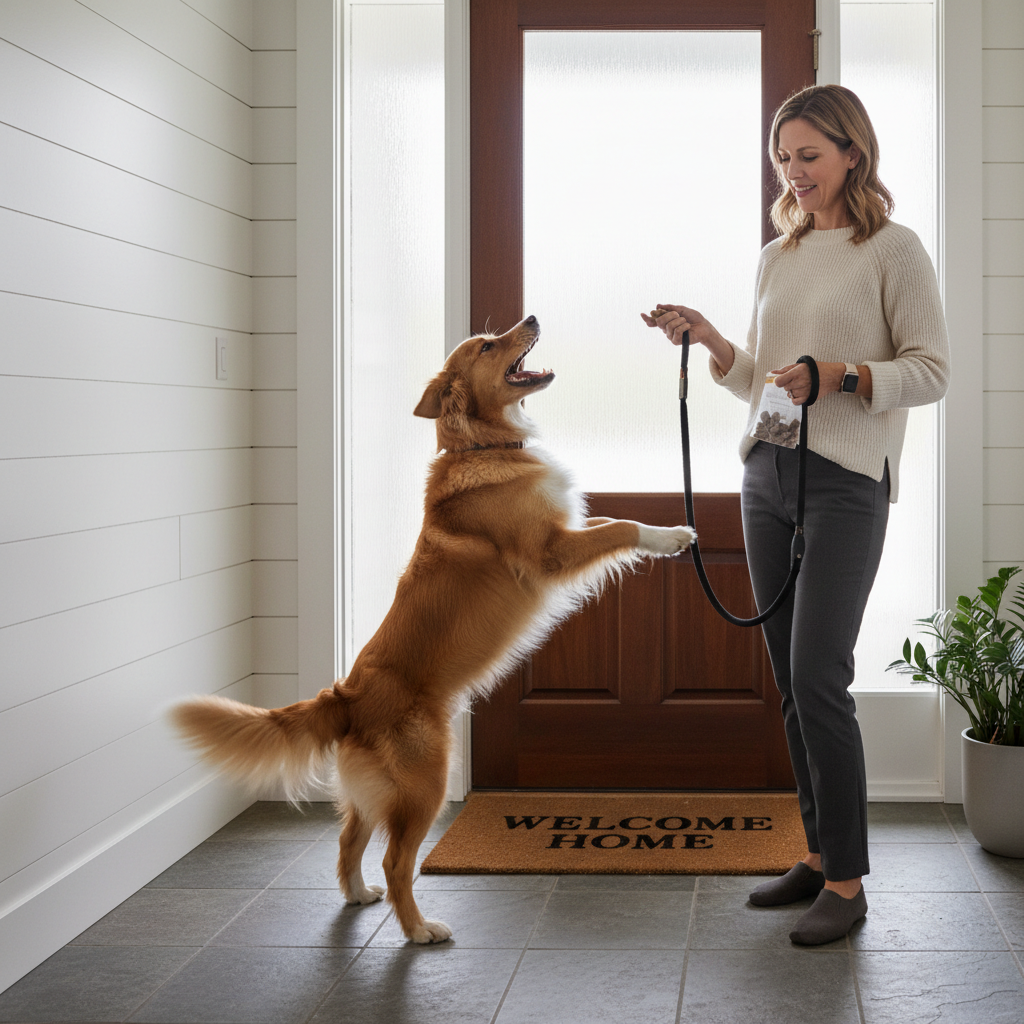
A quick heads-up, door barking can mean different things, alerting, fear, frustration, or overexcitement. The plan below helps you figure out which one you’re dealing with, then gives steps that fit real life, delivery drivers, kids coming in and out, and guests who don’t always follow instructions.
Why dogs bark at the door (and why “shushing” rarely fixes it)
Most door barking has a trigger, a payoff, and a habit loop. If you only address the noise, you miss the loop, and the barking returns.
- Alerting and territorial behavior: The doorbell or knock predicts “someone is here,” and barking feels like a sensible warning.
- Fear or uncertainty: Some dogs bark because people entering feels unsafe, especially with limited socialization or past scares.
- Demand barking: Your dog learned barking makes you move, talk, or open the door faster.
- Barrier frustration: The door blocks access, so the dog barks because they can’t get to the person outside.
- Overstimulation: Fast footsteps, voices, and your own rush to answer can push a dog over threshold.
According to the American Veterinary Society of Animal Behavior (AVSAB), reward-based training and behavior modification are recommended approaches for common behavior challenges, especially when fear or anxiety plays a role.
Quick self-check: what type of door barking is this?
Before you train, take 30 seconds and identify the pattern. This saves time because the “right” solution for demand barking can backfire with fear barking.
Use this checklist
- Body looks loose, tail wagging, rushing the door: often excitement or frustration.
- Stiff posture, hard stare, hackles up: often territorial or uncertainty.
- Barks stop the moment the door opens: often demand or “I made it happen” habit.
- Barks continue, dog backs up or retreats: often fear-based.
- Only barks when home, not in other places: often location/territory specific.
If you see snapping, lunging, or bite attempts, treat it as a safety issue, not just a noise issue.
Set up the environment so your dog can succeed
Training goes faster when the dog stops rehearsing the full-blast routine. Think of this as reducing “practice reps” of barking.
Start with management for 1–2 weeks while you train the skills.
- Block visual triggers: frosted window film or closing blinds reduces “I saw someone” barking.
- Create distance: use a baby gate, exercise pen, or a leash station 6–10 feet from the door.
- Use a white noise source: a fan or white-noise machine can soften hallway sounds and deliveries.
- Move the doorbell: many homes do better with a sign asking guests to text on arrival.
- Prep a treat jar: keep it by the door so you’re not hunting for food mid-chaos.
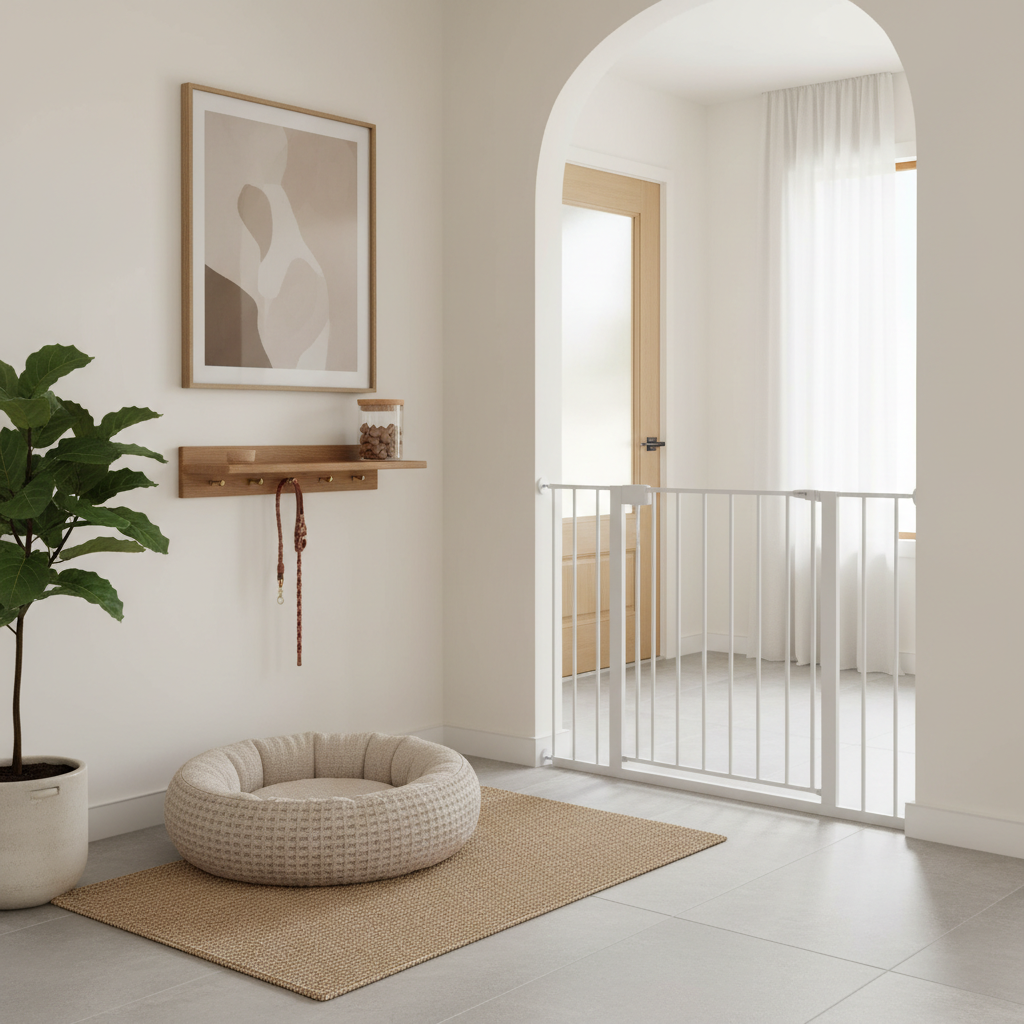
None of this “solves” the behavior by itself, but it lowers the intensity enough for learning to stick.
Teach a clear alternative behavior: “go to mat” beats “stop barking”
Most people try to teach silence directly, but silence is abstract and hard to reward. A physical job, like going to a mat, is obvious, repeatable, and easier to reinforce.
Step-by-step: build a strong mat behavior
- Pick a station: a mat or bed that stays in the same spot.
- Capture the first reps: when your dog steps on it, mark with “yes,” then give a treat on the mat.
- Add duration: feed several small treats one at a time while the dog remains on the mat.
- Name it: say “place” or “mat” right before your dog moves to it, then reward.
- Add distance: send your dog from 2 feet away, then 5, then across the room.
Practice when nobody is at the door. If the mat only appears when guests arrive, many dogs read that as “something big is happening,” and arousal spikes.
Change the meaning of the doorbell or knock (the part most plans skip)
To many dogs, the sound predicts adrenaline. To reduce barking long-term, you want that sound to predict calm, predictable reinforcement instead.
Door sound training (short sessions)
- Get your rewards ready: 10–20 pea-sized treats.
- Make the sound easy: use a doorbell app, a recorded knock, or have someone knock very lightly.
- Sound happens, treats rain: immediately toss 3–5 treats onto the mat or a “treat scatter” away from the door.
- Pause, reset: wait 20–40 seconds, repeat.
Your dog does not need to be silent at the beginning for this to work, but you do need to keep the trigger low enough that they can still eat. If they can’t take food, the setup is too hard.
According to the American Kennel Club (AKC), reward-based methods can help teach alternative behaviors and improve reliability around common household triggers like the door.
Real-life door routine: what to do when someone actually arrives
This is where many households fall apart, because practice sessions look great and then the delivery driver shows up early.
Use a simple routine you can repeat under stress.
| Moment | What you do | What your dog learns |
|---|---|---|
| Doorbell/knock | Say “place,” toss treats to mat | Door sound = go away from door |
| You approach the door | Quietly step between dog and door, keep leash/gate in place | Access is controlled, not chaotic |
| Door opens a crack | If dog holds position, feed; if not, close door and reset | Calm makes the door open |
| Guest enters | Guest ignores dog for 10–20 seconds, you feed on mat | People arriving is not a big event |
Key point: opening the door becomes the reward for calm. If barking makes the door open faster, barking gets stronger over time.
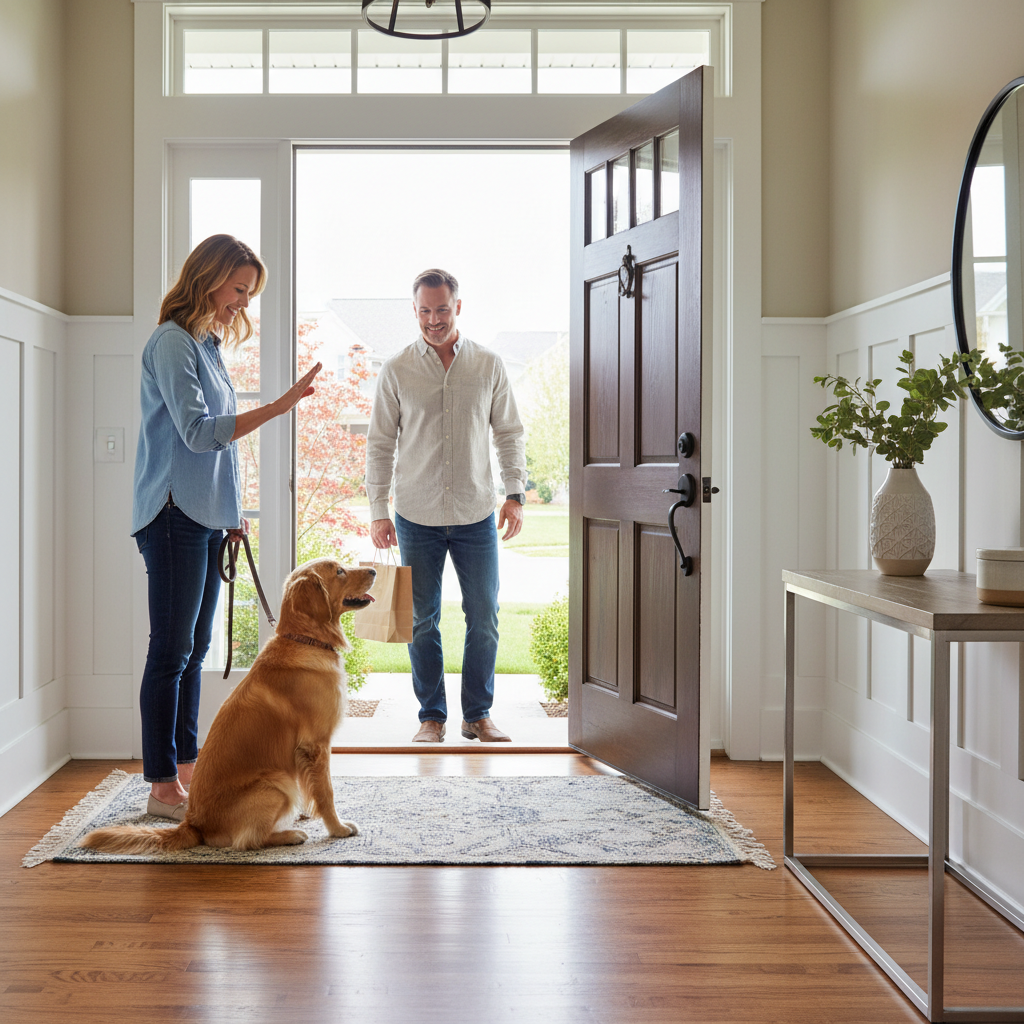
If you live in an apartment or have frequent hallway traffic, you may need more repetitions at “easy volume” before you try full knocks or the real doorbell.
What to do when barking is fear-based or escalating
Some dogs bark because they’re worried, not because they’re excited. In that case, pushing greetings too quickly can increase reactivity.
- Increase distance: put the dog behind a gate in another room, then work on door sounds from farther away.
- Use predictable patterns: door sound, scatter treats, and no forced interaction with guests.
- Coach visitors: no leaning over, no reaching to pet, no direct staring, let the dog approach if they choose.
- Consider muzzle training: if there is any bite risk, a properly introduced basket muzzle can add safety, ideally with professional guidance.
According to the ASPCA, positive reinforcement and gradual desensitization are commonly recommended for fear-related behaviors, and punishment can make fear responses worse in many situations.
Common mistakes that quietly keep the problem going
Most households aren’t “doing nothing,” they’re doing a few normal human things that accidentally reinforce barking.
- Yelling “quiet” from across the room: many dogs hear that as joining the alarm.
- Rushing to the door: your speed signals urgency, which spikes arousal.
- Letting the dog rehearse at windows: the habit strengthens even if you train at the door later.
- Rewarding too late: if treats show up after 30 seconds of barking, you may reward the wrong slice of behavior.
- Expecting guests to fix it: visitors help, but the routine has to work even with imperfect humans.
If you use tools marketed to “stop barking,” be cautious. Some aversive devices can increase anxiety or aggression in certain dogs, and results vary a lot by temperament and timing.
When to get professional help (and what to ask for)
If your dog’s door barking comes with growling, snapping, intense lunging, or panic, it’s reasonable to bring in a qualified professional sooner rather than later.
- Look for a certified trainer or behavior consultant who uses reward-based methods.
- Ask how they handle fear and aggression cases, and whether they will customize a door routine for your home.
- If anxiety seems likely, consider talking with your veterinarian to rule out medical factors and discuss behavior support; medication can be appropriate in some cases, but it depends on the dog.
Key takeaways and a practical next step
If you want how to stop dog from barking at door to stick, stop thinking “silence” and start thinking “replacement behavior plus new associations.” Management prevents constant rehearsals, the mat cue gives your dog a job, and door-sound practice changes the emotional surge that fuels barking.
Pick two actions for this week, set up a gate or leash station near the entry, then run five 1-minute door-sound sessions across the week. That small, boring consistency usually beats one big “training day.”
FAQ
How long does it take to stop a dog from barking at the door?
It varies, but many households notice improvement within a couple weeks if they prevent rehearsal and practice short sessions. Long-standing habits or fear-based barking can take longer and may need professional support.
Should I ignore my dog when they bark at the door?
Ignoring sometimes helps with attention-seeking, but door barking often has other drivers. If the barking is fueled by alerting or fear, ignoring alone rarely changes the trigger response.
What if my dog won’t go to the mat when the doorbell rings?
That usually means the trigger is too intense. Lower the difficulty with softer knocks, more distance, and higher-value treats, then rebuild the “place” habit before you test real-life arrivals.
Does teaching “quiet” work for door barking?
It can help as a finishing skill, but it’s not the best starting point. Teaching “go to mat” or “find it” often works faster because you can reward something visible and consistent.
Are bark collars a good idea for stopping door barking?
Some people try them, but outcomes vary and there are potential welfare and anxiety concerns, especially for fearful dogs. If you’re considering one, it’s smart to consult a qualified trainer or veterinarian first.
My dog barks at the door even when nobody is there, why?
Many dogs react to hallway noises, scents, or distant sounds you barely notice. White noise, blocking window views, and practicing door-sound desensitization can reduce those “false alarms.”
What’s the best treat for doorbell training?
Use something your dog values enough to stay engaged, small pieces of chicken, cheese, or a favorite soft training treat. The best choice is the one your dog will eat even when slightly excited.
If you’re dealing with constant deliveries, a busy household, or a dog that escalates fast, a trainer can help you tighten the routine and adjust the setup so it fits your space and your schedule, which often makes the plan feel doable again.